With World Ocean Day just gone by I would like to draw your attention to something that I have just been made aware of. Stony Coral Tissue Loss Disease (SCTLD). Yes, you would think with being an old scuba instructor with over 30 years of diving under his belt, he should have known or heard of this already.
It all started with a simple quest for more knowledge. I have been using 242dive.com really as a personal logbook of all the underwater adventures we have been having. It is also meant to showcase the great Bahamian aquatic world I love so much. My hope will encourage more people to visit, maybe try a discover scuba course, or give underwater photography a shot.
So, the website, at least in my mind, is something of an unbiased resource guide. It lists dive operators that we have actually dove with, dive sites (and their locations) that we have been too. Yet with all of this, there was and is something missing – I didn’t just want to show the beautiful wrecks, corals, sponges and amazing marine life, It must also tell people what they are looking at and be a source of information – else it’s just a pretty picture. Only problem, I am not at all knowledgeable in this field.
So what to do? Using the logic that the only stupid question is one that is not asked. I began my journey of discovery. We are blessed to have a very good dive club on island and a whole lot of talented members from all walks of life. (I would highly recommend joining!)
One of their members is Dr. Karlisa Callwood. She lives on island and is the Director of Community Conservation Education & Outreach for the Perry Institute for Marine Science. When I got introduced to Dr. C, I knew I had a million questions to ask her!
I mean who better to ask about coral! She said she would love to help and started to look at some of the photos on 242dive.com. What’s really cool, is that not only did she give me the scientific names – but also what they are commonly called. Hahahaha – she knew who she was dealing with!
But that is where the good news ended. I will quote from our initial chat … “In pic 8634 there’s Dendrogyra cylindricus (pillar coral); Dichocoenia stokesii (elliptical star coral), and I think Meandrina meandrites (maze coral), BUT several of those corals look like they have Stony Coral Tissue Loss Disease 😢 “
Up to this point in time I was blaming the death of corals on divers that either did not have the best buoyancy control or could not stop touching everything they see.
Well, now I had more questions and the answers I got were not that promising…
What is Stony Coral Tissue Disease?
Stony Coral Tissue Loss Disease (SCTLD) is a highly contagious and fatal coral disease. Of the approximately 45 species of stony corals in the Caribbean, more than 20 species can catch SCTLD. Some of the most susceptible species are brain, pillar, start, and starlet corals. The highly susceptible species are the first to become infected and the fastest to die. Coral survival rate once infected by the disease in extremely low. Once infected, small colonies can die within a week or two. Larger “dinosaur” corals (those that took hundreds of years to achieve their massive size) can die within a couple of weeks. The exact cause of the disease is unknown. Researchers believe it is caused by a bacterium, virus, or a combination of the two and is transmitted through the water column or direct contact via divers, boats, fish, etc.
How can divers identify SCTLD?
They say a picture is worth a thousand words – so a video must be worth more?
Is it a regional thing?
It’s actually Caribbean-wide. SCTLD was first discovered off the coast of Miami in 2014 and has spread to more than 20 Caribbean countries, making it a pandemic. It was first detected in The Bahamas in reefs near Freeport in December of 2019 by researchers from the Perry Institute. Since then, it has been confirmed on reefs around other islands in The Bahamas, including Grand Bahama, New Providence & Rose Island, Eleuthera, San Salvador, Long Island, Abaco, Exumas and the Berry Islands.
Here is a timeline of initial outbreaks of SCTLD in countries across the Caribbean.
2014: Florida (USA)
2017: Jamaica
2018: Mexico, Sint Maarten
2019: US Virgin Islands, Dominican Republic, Turks and Caicos, Saint-Martin, Belize, Sint Eustatius, The Bahamas, Puerto Rico
2020: British Virgin Islands, Guadeloupe, Cayman Islands, St. Lucia, Honduras, Martinique
2021: Saint Barthélemy, Dominica
Can it be cured?
While there is currently no cure for SCTLD, there has been some success in halting progression of the disease in infected corals. We can slow the spread by applying an antibiotic paste along the diseased edge. This stops the infection from taking over an entire colony, although it does not help to recover the live tissue that is already lost. We have recently begun these treatments here in The Bahamas, although it may be too late for coral colonies in some areas.
What can divers do to help? Divers can help by doing a couple things. First, please report sighting of SCTLD in The Bahamas to https://www.perryinstitute.org/sctld. Sightings while diving throughout the greater Caribbean can be reported to: https://www.agrra.org/coral-disease-outbreak/. You can also find information on both of these websites on how to identify the distinctive pattern of the disease.
Second, divers can help us limit how the disease is transported by humans. After each dive, be sure to sanitize your gear by dunking it in a bucket of sea water and sodium percarbonate before moving to another dive location, especially if you spot the disease. Sodium percarbonate is commonly found in eco-friendly laundry detergent (like Earthbound Elements, 7th Generation, Tru Earth). And encourage dive shop operators to make this a regular practice.
Also, if you’re a boater, be careful not to carry any bilge water between reefs. Your bilge should also be disinfected with a natural detergent and released into open water.
*A special thank you to Dr. Callwood for her help on this article

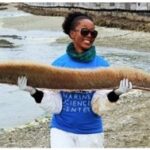 One of their members is Dr. Karlisa Callwood. She lives on island and is the Director of Community Conservation Education & Outreach for the